|
COMING INTO FOCUS
A look at one failed surgery and how new LASIK technology might fix such mistakes
SAN FRANCISCO, Calif.--(San Francisco
Chronicle Magazine)--Nov.9, 2003--
When Dr. Edward Manche tells the story, he changes the names to protect
the privacy of his patient. The only problem is it sometimes starts out
sounding as if it might be the setup for a bit of ophthalmological black
humor:
Lady goes into a clinic for laser eye surgery. Afterward, the doctor
comes over and tells her, "Congratulations, Miss Jones. Everything
went fine." She looks at him, puzzled, and not only because she
can barely see his face. "That's good," she says, "but
I'm Miss Smith."
It's no joke.
"Miss Smith," in this case, turns out to be Gena Steward,
a crime lab technician for the Livermore Police Department, who is now
being treated by Manche. He hopes he can repair the damage done by another
surgeon, who performed someone else's LASIK procedure on Steward's eyes.
She needs her eyes even more than most.
Steward studies fingerprints and analyzes evidence at crime scenes for
a living. Although she never wore glasses in high school, by her mid-30s
she was finding it difficult to get by without them, unable to make out
street signs and license plates unaided. But sometimes the glasses interfered
on the job,
such as when she had to put on self-contained breathing gear at suspected
arson scenes.
On Oct. 17, 2000, Steward went to Horizon Vision Center in San Leandro
to have the popular LASIK procedure - "laser-assisted in-situ karatomileusis" -
done on both eyes, convinced it would free her of the hassle of glasses
or contact lenses. The surgeon was Dr. David B. Davis II. He was a veteran,
licensed to practice medicine since 1959, father of someone Steward had
known since high school. Some 20 years before, Davis had performed cataract
surgery on Steward's grandmother.
Davis was one of a team of surgeons at the San Leandro center, part
of a network of seven "state-of-the-art laser vision correction
centers" operated by the Horizon chain in the Bay Area and Sacramento.
The chain boasts a combined track record of more than 50,000 successful
procedures.
Steward's case is not one they boast about.
"Miss Jones" was to have been another patient at the center.
She, too, had an appointment with Davis on Oct. 17. Hers was to be his
first case of the day. Steward was to be second.
Both women's eyes had already been examined. Early that morning, a technician
fed the data for "Miss Jones," who was severely nearsighted,
into the computer that guides the laser. Based on these settings, the
laser would sculpt her cornea just so, within a few seconds eliminating
a lifetime of vision problems.
But "Miss Jones" never showed up that morning.
"Miss Smith" - Gena Steward - wishes she hadn't, either.
Now 68 years old, Davis has since retired and moved to Washington state.
"This was very traumatic for me," he said during a telephone
interview, although he insisted he didn't quit practicing medicine because
of the Steward case. "I've never had anything like that happen before."
He was forthright about what happened, even after I had to decline his
request to keep his name out of it. He said he considers the matter over
as far as he is concerned, and that he hopes Steward is on her way to
recovery now that she is in Manche's capable care.
"For reasons which I don't remember," he said, "the first
case was held up. So Gena was brought in, and the technician apparently
thought she was still the patient from the first case. The calculations
for the first case were left in the computer on the laser. I did not
check the readings. That was my mistake there. I'd been doing them so
long I think I just took it for granted. That's how it happened. So she
was treated for a very severe nearsighted amount, when she was not."
Steward had no idea what had happened when she was led into a darkened
room after the procedure. Everything was a blur, she said. Nobody told
her so at the time, but she already had a strong inkling something was
terribly wrong.
"I was sitting in this dark room - blind," she recalled. "I
was scared to death. But I didn't know at the time if this was normal
or what."
It most certainly was not normal. Steward had just become one of the
1 percent or so of LASIK patients who wind up seriously unhappy with
the results of one of medicine's most successfully marketed elective
procedures.
Attracted by ubiquitous advertising and growing word-of-mouth from satisfied
customers, nearly 1.3 million Americans are expected to have a LASIK
procedure this year, up from a little over 1.1 million in 2002. Six million
have had it since 1995, when the first laser equipment for vision-correcting
eye surgery was approved by the U.S. Food and Drug Administration.
In the early days, about 10 percent of patients wound up with some sort
of complaint, such as seeing halos around lights and other night-vision
problems. By all accounts it was an unacceptably high problem rate for
an elective procedure, and doctors have been successfully trying to improve
outcomes in recent years.
"In the last five years, that's dropped to about 3 percent. But
even at 3 percent, if you are talking about 6 million people, it's a
big number," said Dr. Daniel Durrie, an eye surgeon in Kansas City
and a national spokesman for the American Academy of Ophthalmology.
He and other doctors warn that anybody considering a LASIK procedure
needs to keep the risks in mind. Most of the worst cases of post-LASIK
complications involve problems with the surgical flap - a circular outer
layer of the cornea that is cut and peeled back before the laser is applied,
then flopped back over the corrected eye, healing back into place.
The little LASIK flap that is raised up can wrinkle, or tear if it's
too thin, or get a hole in it.
That sort of complication used to happen about once in every 100 cases.
Now the flap problems have been
reduced to about one in every 1,000 cases. Some very recent statistics,
according to Durrie, suggest the real risk nowadays, in the hands of
a capable surgeon using the latest equipment, might be as low as one
in 10,000.
But as Steward's case shows, a badly done LASIK flap is hardly the only
thing that can go wrong.
Dr. Richard Abbott, a clinical professor of ophthalmology at UCSF Medical
Center, has done laser eye surgery on hundreds of patients, including
his own wife, with excellent results. But he has declined to have it
done on his own eyes, even though he is legally blind without glasses,
20-200, with nearsightedness and astigmatism.
"The key thing patients need to know, which is obvious to those
of us in this profession but is not obvious to a lot of people, is that
this is surgery,
and in surgery things can wrong. There can be complications, and sometimes
they can be very difficult to fix," he said.
"All kinds of things can go wrong," he continued. "There
may be problems in the mechanics of doing the procedure. There can be
physician problems, equipment problems, data problems, transfer of data
problems. The data entry into the laser may be off, and that might be
missed."
There can be patient problems, too.
"Most people have a very high expectation for this procedure," Abbott
said. "They end up with less than perfect results, and that makes
those people very unhappy. Most people do extraordinarily well, but it's
not for everybody."
After about an hour in the dark after her surgery, someone told Steward
she could go home for the day, but to come back the next day for the
standard post- operative followup check of her eyes. Davis tried to reassure
her, Steward recalled, suggesting the extreme blurriness she was experiencing
should clear up by the next morning.
She was given no explanation of what had happened, no hint of any glitches,
even though Davis said he realized what had happened soon after the procedure
was over. He just decided to keep it to himself for a while.
"I was absolutely in shock when I found out," he said. "I
was going to tell her immediately, and then I consulted with another
physician, who said the result 'may not be as bad as you think, so wait
a little while, let it settle down. Fit her with contact lenses and make
sure she's seeing well, and then talk about it.' "
"That was my big mistake," Davis said. "I should have
told her right away."
Steward, unaware, didn't know enough to ask why she wasn't given a name
tag to wear. Because she couldn't see the road, much less make out street
signs, a friend drove her home, where she spent most of the day in bed,
feeling her way around when she had to get up.
Her father took her back for the follow-up exam the next morning. She
was more than a little upset. Even though she had been warned to expect
some cloudy vision to persist for a while after the surgery, something
just didn't seem right.
"My dad had to lead me by the arm into the doctor's office," Steward
said. "He examined me, and said I had had an adverse reaction to
the procedure. It was just something in the way my body reacted. He wouldn't
explain it to me beyond that. He wanted to have me fitted for contacts.
He just said the optometrist would fit me for contacts to try to get
me to see better."
Davis knew exactly what had gone wrong. But he said he was hoping that
Steward's eyesight would improve over time, or that another operation
might be able to fix any residual defects.
Sometimes, a situation that looks like disaster may look much different
as the eyes heal and the cornea gradually changes contour. Sometimes,
even big overcorrections with a laser have a tendency to ease back toward
normal on their own. And sometimes, even the stopgap measures don't work:
Steward's eyes were in such bad condition it proved impossible even to
make contact lenses work properly anymore.
"Deep in your heart, you think, 'This is not really happening,' " Davis
said.
In Manche's Stanford office, the big buzz lately is the arrival of yet
another new technology. He is one of about 1,500 surgeons across the
country certified to use the new $65,000 system called "CustomVue" by
manufacturer VISX of Santa Clara, based on a technology known generically
as "wavefront."
It uses multiple "lenslets" and a laser beam that can be fired
into the eye,
then measured precisely in a couple hundred different locations as the
beam bounces back off the retina. Any aberrations, any photon-slowing
thicknesses in the cornea that shouldn't be there, will be picked up
by the software. Then,
once that data is captured, the same information can be used to guide
the laser that zaps away - "ablates" is the preferred word
- the offending corneal areas.
"It's very good for treating irregularities in the shape of the
cornea that we could not treat up until now, whether the irregularities
were induced by a LASIK procedure or were something a person was just
born with," said Dr. Roy Rubinfeld, a LASIK specialist who practices
in the Washington, D.C., area. "It's one of the most important things
to come along in LASIK for a long time."
This turns out to be the very same technology that has revolutionized
astronomy, where it's called "adaptive optics." Telescopes
so equipped can measure light-distorting aberrations in the atmosphere,
then make appropriate mirror adjustments for a clear view of distant
objects.
In the eye doctor's office, it might be just the ticket for fixing Steward's
badly fried corneal tissue. To illustrate how it works, Manche and an
assistant turned off the roomlights and sat me down in front of the testing
device, a chunky beige box with a chinrest and a place to lean your forehead
so your eyes are trained straight ahead.
A blinking light came on. I focused on the light. Manche was looking
at a screen off to one side. First one eye, then the other. The lights
came back on.
We did it all again in front of a different machine in another examining
room,
which produces something called "Orbscans."
I was handed several color printouts, pairs of images, one per eye. "Something
for your refrigerator," Manche said.
One image was an "acuity map," which looked like a green kidney
bean floating in yellow soup, slivers of orange carrots at the edges.
The other image showed "wavefront high order aberrations" -
wiggly amoebas of some sort, splotches of different shades of green and
blue.
There was a table showing all my "Zernike coefficients."
I had one pupil diameter of 4.32 millimeters. The other was 5.08 milimeters.
There was a "posterior float" and an "anterior float,"
depicted as circles with indecipherable but alarmingly asymmetrical
splotches of color. There were words like "astigmatism" and "effective
blur," and numbers like "-0.82 DS" and "+0.61 DC
x 45 degrees@ 12.5 mm (4.0 RX calc).
To me, squinting, it looked dreadful.
I have never had to wear glasses until recently, as my eyes have been
getting noticeably weaker with the onset of middle-aged presbyopia -
a problem that cannot be treated with lasers. Except when I am trying
to read, I can skip the glasses even now. And now here I was being told
that my pupils weren't even the same size.
In fact, Manche said, I had little to be concerned about, other than
some myopia and a bit of astigmatism in one eye, which the last eye doctor
I visited told me about anyway.
Steward's pictures all look about the same, but to a practiced eye tell
a much different story. Her pre-operative readings of minus 1.25 diopters
- a neutral zero is the ideal - in each eye with no astigmatism meant
just minor nearsightedness, something seemingly tailormade for a LASIK
operation to correct.
But after Davis was through, she was way overcorrected, plus 3.50 diopters,
with an irregular astigmatism now in both eyes. She had 20-45 vision
before; after the surgery, she was 20-200.
Guys at the Livermore P.D., who were "extraordinarily supportive" throughout
her ideal, Steward said, now couldn't resist a little gentle
humor of their own, congratulating Steward on having just become "the
world's first blind fingerprint examiner."
Wavefront" is Steward's hope out of the mess. It amounts to a new
way of testing for defects in the eye that provides much more detailed
readings than before, allowing comparably more exact corrections. Instead
of a single lens in the device used to find the problem based on a lot
of averaging over the entire surface of the cornea, the wavefront device
breaks the cornea into separate areas, each of which is corrected based
on its own peculiarities.
In a field already full of hype, expect even more: Wavefront has been
likened to an evolutionary leap in laser eye correction, like high-definition
television compared to standard TV.
"Results have been absolutely remarkable," Rubinfeld said.
Wavefront gives doctors the ability to fix "defects in vision we
weren't even picking up with the existing testing devices," he added. "We
can treat people who might not find their night vision is as good as
they would like, or have some other type of symptom and would like to
see better."
The real change, doctors say, is not so much in the laser operation
but in the detection of the underlying problems. Wavefront technology
could lead to better contact lenses and eyeglasses, they said, where
laser surgery is not the chosen option.
"We're in a new era of testing eyes," Durrie said.
The new technology is geared to finding "higher-order aberrations" that
were never apparent before, except to the people trying to see through
them. In many cases of post-LASIK complaints, surgeons could find no
explanation for the problem, relying on standard testing methods.
Problems may arise because some people are abnormal in the degree of
slope across the pupil. Someone who measures slightly myopic at the center
of the eye could be much worse out at the edge.
"You could correct the center, but when they look at lights at
night they see halos because we didn't correct the edges enough," Durrie
said. "Now we can diagnose it and correct it with these new lasers."
But some cautionary notes are already sounding.
For starters, the FDA approval for the "wavefront" devices
only applies to procedures done on "virgin eyes" - eyes that
have not had a previous laser procedure. Clinical trials have not been
done yet covering retreatment cases, although doctors are free to use
the new lasers on such patients as medical judgment determines.
There's not enough follow-up data, at least not from patients in the
United States, to predict how people will fare in the long term, despite
the very encouraging early U.S. results and longer experience in Europe.
Dr. Stephen McLeod, vice chairman of ophthalmology and co-director of
the refractive surgery service at UCSF, is adamant that people understand
the limits of the new technology.
It does not appear to be well-suited for fixing "a very abrupt
irregularity in the cornea, one that happens to have a very focal location,
for example, a little lump or fold near the entrance area of the pupil," McLeod
said. Such aberrations, which may arise naturally or from a botched LASIK
procedure, can result in "smudges" or blurry spots in the field
of vision.
A tiny "pinpoint elevation or a very well-defined fold" in
the wrong spot can seriously distort vision but "the laser doesn't
do a very good job of pinpointing the region that needs to be brought
down," he said.
A certain percentage of people who have had a laser correction and are
unhappy with the aftermath have "a very sharp transition from normal
cornea to abnormal cornea," McLeod said, "and that can be very
hard to treat."
Registration, or lining up the laser with the eye, is also "a very
tricky problem," he added.
For Steward, it will take a little more time to tell. She sued Davis,
settled out of court for a tidy sum, which she has tried to keep private
but turned out to be enough to allow her to move into a larger new home
near work.
Manche tried to help her eyesight starting back in December 2000, long
before the wavefront system was ready for widespread use. He recommended
waiting a few more months after the initial surgery, to allow the cornea
to achieve a stable shape, and then do another laser correction on Steward's
right eye, hoping to get at least one eye close to normal.
After the follow-up corrective surgery in May 2001, Manche was able
to improve her vision in the re-treated eye to 20-50, but she still had
the astigmatism. The best a contact lens could achieve was 20-45. One
optometrist said her cornea had been "warped" from the procedure
in Davis' office, making it impossible to fit a lens properly.
A month later, in June 2001, Manche zapped Steward's left eye again,
and this time got much better results: 20-15, sharper vision than normal.
At work, Steward trained herself to use this left eye for all the tough
detail work.
No longer "blind" in both eyes, she decided she could afford
to wait for the wavefront system before submitting for what she decided
would be her last attempt to regain normal vision in her damaged right
eye.
"I just don't want to go through it again," she said.
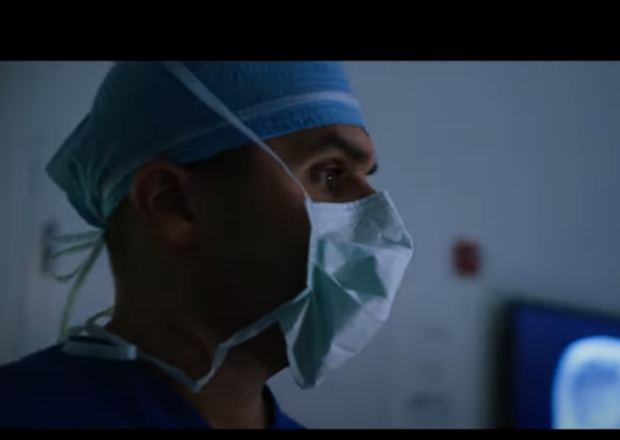
The final surgery was done in early September. A photographer and I
were invited in to watch. It was all over in surprisingly short order.
Other than peeling back the little flap on the surface of Steward's eye,
it seemed little more daunting than the testing routines Manche had put
me through a couple weeks earlier.
After a few weeks, Steward found she could make out the letters on the
20- 20 line on the eye chart with both eyes. Manche said he was pleased
with the progress and anticipated further improvement as the latest eye
to be treated heals.
Steward was also pleased. Not overjoyed, exactly, but certainly happier
than she was before.
"The surface of my eye was all warped before, and now it's all
very smooth, " she said.
Her image of the 20-20 line isn't nearly as "crisp and focused" as
she would like.
"I can see the letters but they're still a little blurry," Steward
said. "But my left eye is really good. My right eye is pretty good.
No glasses. No contacts. So I'm pretty happy with that. I can do my work
now, no problem."
She can even make out road signs again.
Carl T. Hall is a science writer for The Chronicle. |